
Beyond the Binary
A Pragmatic Approach to AI use in Futures Intelligence Research

The debate around artificial intelligence in futures research often falls into two camps: techno-optimists who see AI as a revolutionary force that will transform foresight, and those who warn of bias, opacity, and the erosion of human judgment. Both are important but this binary framing masks the real challenge. The question isn't whether to use AI in futures intelligence but rather, how can we use it with intentional constraint and methodological rigor?

The Reality of Our Current Practice
There is much critique surrounding AI's "black box" nature (and with good reason), but we also need an honest reckoning with our own futures research practices. Much of traditional futures research surfaces similar opacity issues. Synthesis emerges from horizon scanning with implicit assumptions on the part of the scanner, weak signals get prioritized through undocumented processes, and the reasoning chains behind sensemaking are no less at risk of personal and collective bias. We've been operating as human black boxes long before AI arrived on the scene.
This isn't an indictment of human judgment but rather a recognition that the challenges we attribute to AI - confirmation bias, source skew, reasoning shortcuts - are also features of human cognition that AI simply magnifies at scale. The arrival of AI in foresight work presents an opportunity to address these longstanding methodological blind spots.
AI brings undeniable capabilities to futures research. It can process vast volumes of data, identify patterns across disciplines, and generate initial scenarios at unprecedented speed. Many organizations have demonstrated how AI can enhance environmental scanning and complexity analysis when properly integrated with human oversight.
Yet the risks are equally real. AI's training on historical data creates what researchers call "data stagnation" an endless reinforcement of existing patterns that may miss genuine discontinuities. The "average of the average" problem means AI gravitates toward consensus futures, potentially overlooking marginal voices and transformative possibilities. Most concerning is the AI-trust paradox: fluent, authoritative-sounding outputs that can easily mask fundamental inaccuracies or fabricated sources.
The Intentional Constraint Imperative
The path forward requires us to act with "intentional constraint" - deliberately limiting AI applications to areas where human oversight can effectively validate outputs while maximizing analytical capabilities. This means using AI for data processing, pattern recognition, and initial scenario generation while reserving interpretation, verification, ethical judgment, and strategic decision-making for human experts.
Successful implementations demonstrate that AI can excel at:
Rapid horizon scanning across massive datasets
Cross-disciplinary synthesis and pattern identification
Initial scenario generation and variation
Trend analysis and weak signal detection
But humans remain essential for:
Interpreting ambiguity and cultural nuance
Making ethical and value-based judgments
Imagining truly discontinuous futures
Understanding context
Nuanced synthesis and sensemaking
Human Machine Collaboration in Research
There’s been chatter recently in the futures and foresight space regarding the Dubai Future Foundation’s release of a Framework for Research and Publications Standards for Human-Machine Collaboration.
For context; the 2024 Dubai Future Foundation : The Global 50 Report which identifies future opportunities to improve growth, prosperity and wellbeing surfaced an interesting question - What if we had a Turing declaration for human intelligence?
A critical question in an age where machine language and intelligence is increasingly becoming indistinguishable from human language and intelligence. You can see the Dubai Future Foundation’s guidelines below.
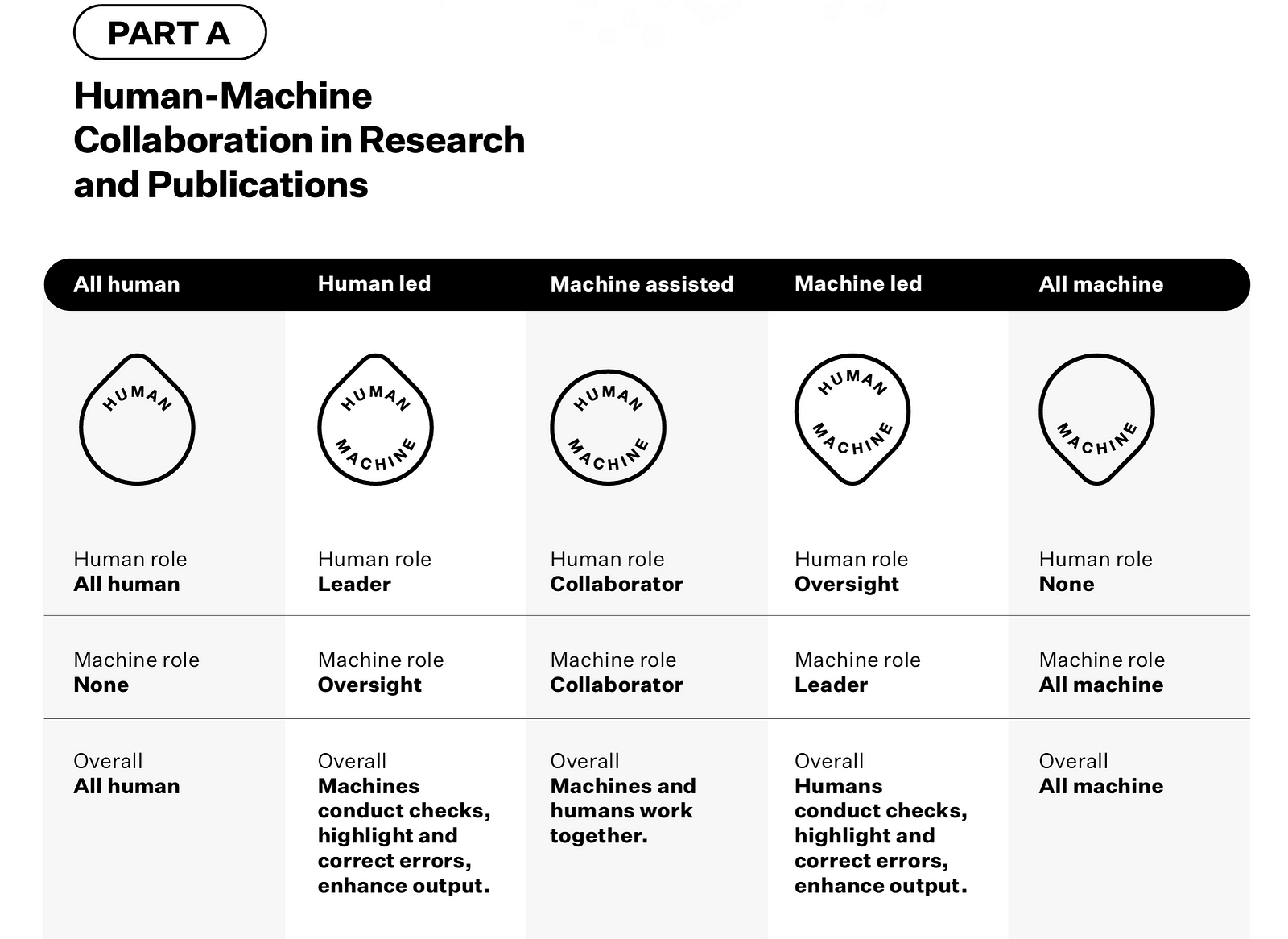
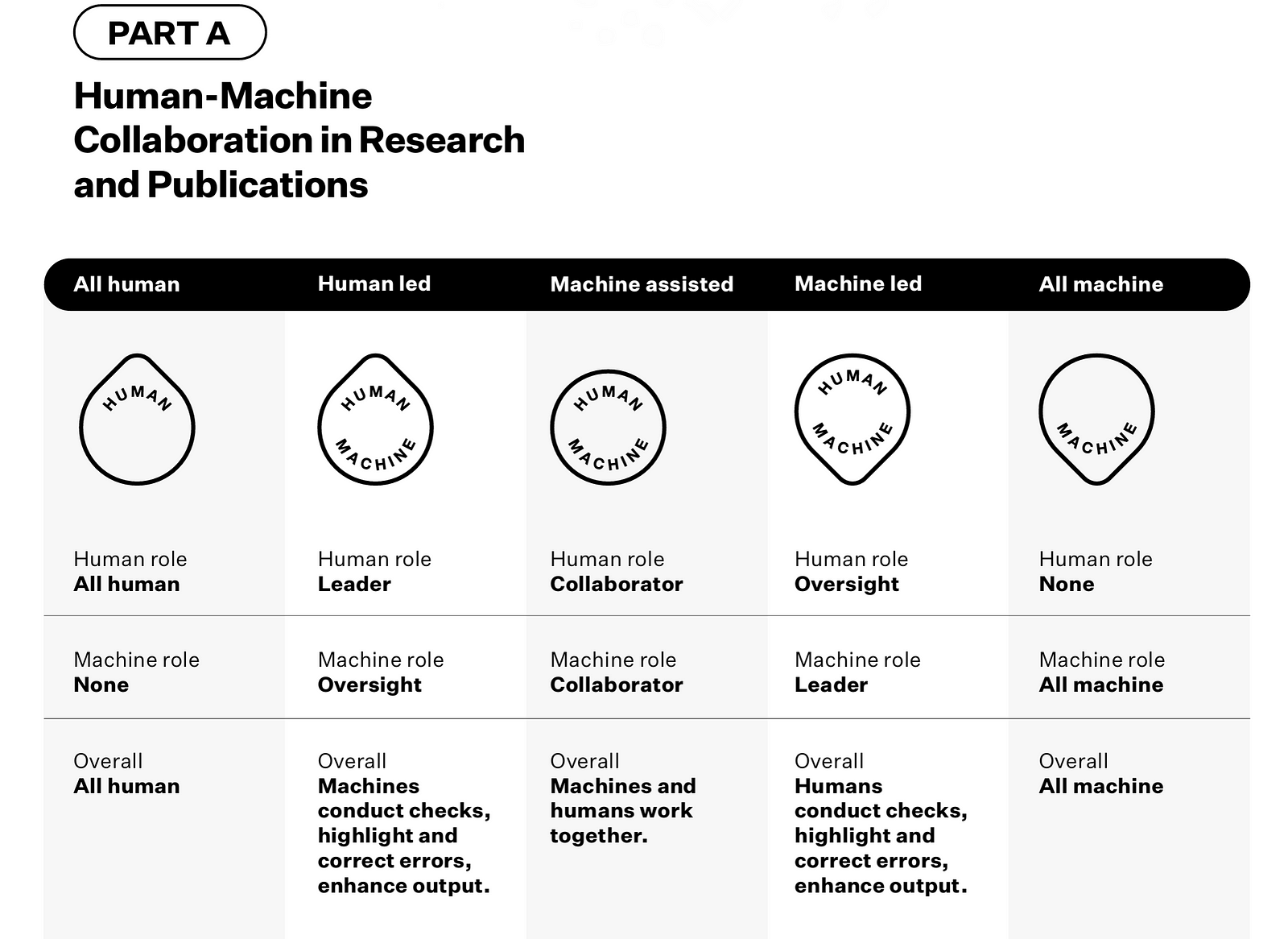
The Dubai Future Foundations framework marks a laudable move toward transparency by signalling the extent and role of human vs. machine involvement in research outputs, however its scope remains fundamentally narrow. By focusing predominantly on who authored the output or where AI was used in the process - through icons denoting human-led or machine-assisted roles - the framework offers only a superficial layer of disclosure.
It doesn’t address the far more critical issue of the Chain of Thought - the reasoning pathways, mental models, and interpretive moves that underpin foresight and scenario work.
In futures intelligence research, real transparency means revealing the logic, assumptions, alternative hypotheses, and key decision points that gave rise to each insight. Without that, we risk repeating the same epistemic blindness that plagues opaque AI systems. The real risk is not just undisclosed AI involvement, but the invisible biases and blind spots embedded in our unrecorded reasoning.
Chain of Thought Transparency: What AI Can Teach Us About Ourselves
As AI researchers and developers grapple with the need for transparency in machine reasoning, a growing movement has emerged calling for the Chain of Thought (CoT) of AI systems to be visible, auditable, and understandable. Whether it’s through interpretability tools, model disclosures, or prompting strategies that elicit intermediate reasoning steps, the goal is clear - understand how the machine got to its answer, not just what the answer is.

Human Futures Work Is Not Immune to Opaqueness
Why Our Own Chains of Thought Matter
Despite the field’s emphasis on criticality and systems thinking, futures work often moves through intuition, systems sensing, narrative construction, and abductive leaps. That’s part of its power. But when our outputs are packaged as "drivers," "clustered signal themes," or "insights”, we often leave behind the chain of thought that got us there. The assumptions we made, the framings we privileged, the worldviews we filtered through - all of this is often assumed as neutral.
In other words, while we question AI’s CoT opacity, we often accept the opaqueness of human-led foresight as a given. This has led to an epistemic double standard: we hold machines to a standard of traceability and transparency that we often don’t require from ourselves.
The result? Our futures can be just as opaque. They can’t be interrogated, iterated on, or meaningfully challenged. In this way, we become the black box.
What Intelligence Analysts Can Teach Us
One field that’s confronted these challenges head-on is military and national security intelligence. Since the 1970s, intelligence professionals have developed a suite of Structured Analytic Techniques (SATs) to explicitly counter cognitive bias, improve analytic traceability, and create shared transparency in team-based decision-making.
These include methods like:
Analysis of Competing Hypotheses (ACH): Forces analysts to consider multiple, often contradictory explanations simultaneously.
Key Assumptions Check: Makes all underlying assumptions explicit so they can be stress-tested.
Indicators and Signposts: Tracks emerging developments tied to specific future hypotheses.
Devil’s Advocacy and Red Teaming: Systematic exploring of contrarian perspectives to counteract groupthink.
The usefulness of these techniques isn’t that they eliminate bias, but rather that they make it visible. They allow for a shared, inspectable explicit “chain of thought” that others can interrogate, extend, or refine.

Modeling AI’s Transparency Standards
The arrival of AI in foresight may, paradoxically, be the thing that forces us to confront the cognitive and methodological blind spots in our own practice.
Just as AI CoT researchers are asking:
“What logic did the model use to arrive at this conclusion?”
Futures intelligence researchers should ask:
“What interpretive steps did we take to construct this cluster?”
What if every foresight output included a documented CoT - a structured trail of assumptions, sources, mental models, alternative hypotheses considered and rejected? What if we designed foresight processes that were inspectable by default, not just polished on delivery?
This wouldn’t undermine creativity - it would protect and empower it. Because when others can see how we thought, they can expand, refine, remix, or even contest it. That’s the foundation of collective intelligence.
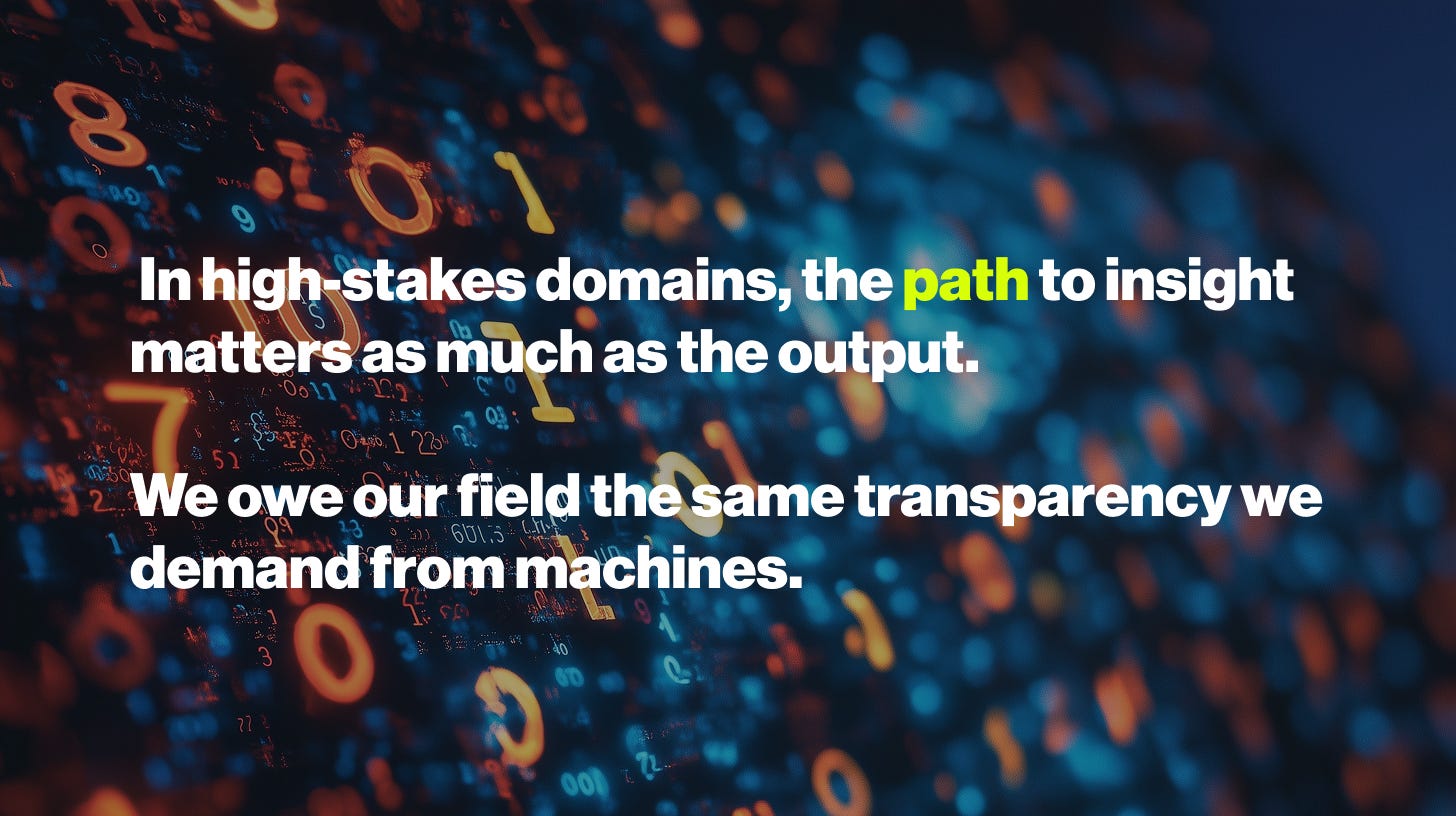
This push toward visible reasoning isn’t just a technical fix. It’s a recognition that in high-stakes domains- law, medicine, military, policy - the path to an insight matters as much as the outcome. It shapes our ability to trust, challenge, and build upon it.
Shouldn’t we as futures intelligence researchers should hold ourselves to the same standard?
The Future of Futures Intelligence Is Open
There’s a poetic symmetry here: the very concerns we level at AI - opaqueness, bias, unaccountable reasoning - are opportunities for reflection on our own epistemic practices.
If we expect AI to “show its work,” then we must be willing to show ours.
What if we treated the “Chain of Thought “not as an AI artifact, but as a shared research design principle for all anticipatory practice, for human and machine alike.
What would it look like in practice?
Document the Chain of Thought [CoT]
Treat your reasoning process like source code: make it visible. Capture and share the assumptions you made, the paths you didn’t take, and the rationale behind key scenario choices. Whether through annotated maps, logic trees, or decision journals, make your thinking inspectable by others.
Stress-Test Your Assumptions
Borrow from structured analytic techniques: run key assumption checks, red-team your own insights, and consider competing hypotheses. These practices expose blind spots and make bias visible before it calcifies into foresight.
Invite Interpretation, Not Just Consumption
Create synthesis that invites interrogation, remixing, and challenge. Transparency builds trust, but it also fosters collective sensemaking, inviting foresight as a kind of participatory inquiry.
Toward Accountable Futures Intelligence
The irony is that AI's arrival may be exactly what the field needs to confront its own methodological limitations. If we demand transparency from machines, we must hold ourselves to the same standard. If we worry about AI's biases, we must systematically address our own.
This isn't about choosing between human wisdom and artificial intelligence or even just labelling our process as human vs machine. It's about creating robust methodologies that leverage both, while acknowledging the limitations of each.
The future of futures intelligence lies not in the wholesale adoption or rejection of AI, but in thoughtful integration that preserves what makes foresight both rigorous and creative. By embracing intentional constraint and methodological transparency, we can harness AI's analytical power while maintaining our essential role as sense-makers and navigators of possible futures.
The choice before us isn't binary. It's about crafting a practice where human imagination and machine intelligence exist in productive tension, each checking the other's blind spots while amplifying their respective strengths. In this approach, AI becomes not a replacement for human judgment but a catalyst for more rigorous, transparent, and imaginatively bold futures thinking.